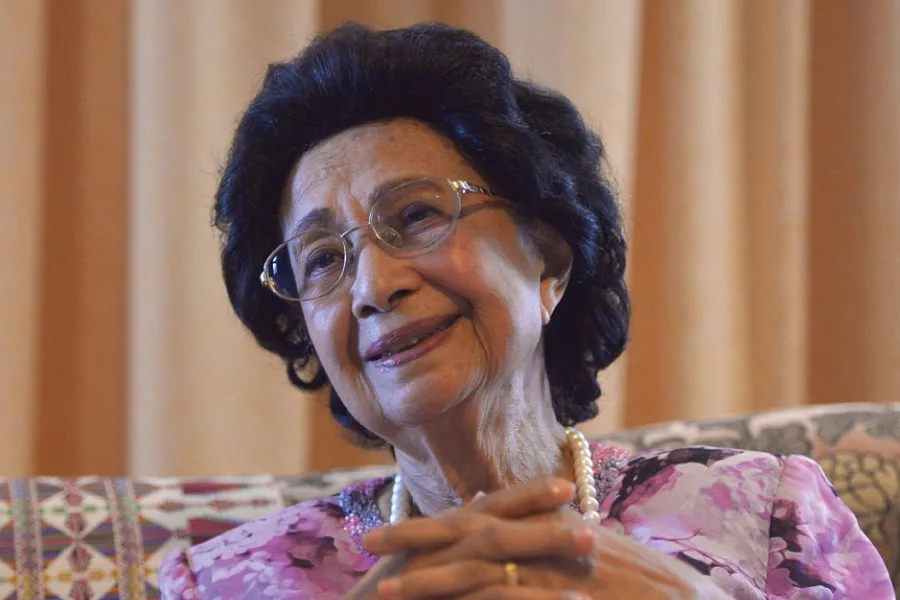
Tun Dr Siti Hasmah Mohd Ali, one of Malaysia’s pioneering women doctors and a prominent advocate for public health, died on 28 September 2026 at the age of 100.
While many Malaysians knew her as the wife of former Prime Minister Tun Dr Mahathir Mohamad, Tun Siti Hasmah had a distinguished career of her own.
Her life took her from her early school years in Kuala Lumpur to medical training in Singapore, public health work in Kedah and later back to Kuala Lumpur, where she continued her work in maternal and child health.
Over the decades, she became associated with causes ranging from healthcare and women’s development to literacy, mental health and the prevention of drug abuse.
Her death in Kuala Lumpur in 2026 brought to a close a life that spanned a century of enormous change in Malaysia.
Tun Dr Siti Hasmah Dies at the Age of 100
Tun Dr Siti Hasmah Mohd Ali died at the National Heart Institute (Institut Jantung Negara) in Kuala Lumpur on the morning of 28 September 2026. She was 100 years old.
Her death was confirmed by her son, Tan Sri Mokhzani Mahathir.
The Malaysian government subsequently announced that Tun Siti Hasmah would be accorded a state funeral. She was to be laid to rest at Pusara Negara in Precinct 20, Putrajaya.
Her passing prompted tributes from Malaysia’s King and Queen, national leaders and organisations with which she had been associated during her long public life.
But beyond the tributes that followed her death, Tun Siti Hasmah’s story stretches back to a very different Malaysia.
Who Was Tun Dr Siti Hasmah?
Tun Dr Siti Hasmah Mohd Ali was born on 12 July 1926 in Klang, Selangor, during the period of British rule in Malaya.
She grew up at a time when higher education remained inaccessible to much of the population and opportunities for Malay women to pursue professional careers were particularly limited.
Her eventual decision to study medicine placed her among an early generation of Malay women entering the profession.
Long before becoming one of Malaysia’s most recognisable public figures, she was a doctor and civil servant working in public health.
Her areas of work would eventually include maternal and child healthcare, immunisation, rural health and the development of women and families.
Her Early Years in Kuala Lumpur
Although Tun Siti Hasmah was born in Klang, Kuala Lumpur played an important role in her formative years.
She received her early education at several schools in the city.
Among them were Methodist Girls’ School, St Mary’s School and Pudu English School.
Tun Siti Hasmah would later recall that her father was willing to send his daughters to English-medium schools at a time when some Malay families remained hesitant about doing so.
These experiences meant that her relationship with Kuala Lumpur began decades before she became a familiar national figure.
After completing her schooling, however, the next major chapter of her life would take her away from the city.
Becoming One of Malaya’s Early Malay Women Doctors
In 1947, at the age of 21, Siti Hasmah travelled to Singapore to enter the King Edward VII College of Medicine.
It was an unusual path for a Malay woman of her generation.
She graduated as a medical doctor in 1955 from the Faculty of Medicine of the University of Malaya, which was then based in Singapore.
After graduating, she returned to Kuala Lumpur and completed her housemanship at Kuala Lumpur General Hospital, now known as Hospital Kuala Lumpur.
This began a public-service career that would last for more than two decades.
At a time when women remained underrepresented in medicine, Tun Siti Hasmah became one of the early Malay women to build a career as a doctor in Malaya.
Building a Career in Public Health
After completing her early medical training, Tun Siti Hasmah served as a medical officer in Kedah.
Her career increasingly focused on public health, particularly the health of women and children.
In 1965, she became the first woman appointed as a Medical Officer in Kedah’s Maternal and Child Health Department. She was also involved with the Rural Health Training School in Jitra.
Her work brought her into contact with communities outside Malaysia’s major urban centres.
Public healthcare in rural Malaysia during this period presented very different challenges from those faced by large hospitals. Maternal healthcare, childhood immunisation, sanitation, nutrition and access to basic health services were important parts of improving health outcomes.
Tun Siti Hasmah became closely associated with these areas of public health.
In 1974, she became the first woman appointed as Kedah’s State Maternal and Child Health Officer.
That same year brought her professional life back to Kuala Lumpur.
Returning to Kuala Lumpur
Tun Siti Hasmah joined the Institute for Public Health in Bangsar in 1974 as a maternal and child health officer.
Her return to Kuala Lumpur represented another chapter in a relationship with the city that had begun during her childhood.
From attending schools in Kuala Lumpur to completing her housemanship at Kuala Lumpur General Hospital and later working in public health in Bangsar, several important stages of her education and medical career unfolded in the capital.
She also had an association with the University of Malaya, including teaching part-time at its Faculty of Dentistry.
These connections make Tun Siti Hasmah part of Kuala Lumpur’s wider medical and social history as well as Malaysia’s national story.
Marriage to Tun Dr Mahathir Mohamad
Siti Hasmah met fellow medical student Mahathir Mohamad while studying medicine.
The couple married in August 1956, a year before the Federation of Malaya achieved independence.
They went on to have seven children.
For many years, both pursued careers in medicine before Mahathir increasingly entered politics.
Their lives would eventually become intertwined with some of the most significant periods in modern Malaysian political history.
Tun Dr Mahathir served as Malaysia’s fourth prime minister from 1981 until 2003 and later returned as the country’s seventh prime minister from 2018 until 2020.
As his wife, Tun Siti Hasmah occupied a highly visible public position during both periods.
However, her public identity continued to draw heavily from her earlier experience as a doctor.
From Doctor to a National Public Figure
When Dr Mahathir became prime minister in 1981, Tun Siti Hasmah became increasingly involved in national and international activities.
Healthcare remained one of the recurring themes of her public work.
Over the years, she was associated with initiatives involving maternal and child health, family welfare, rural women, literacy, mental health and efforts to prevent drug abuse.
She also represented Malaysia at international events.
In 1995, Tun Siti Hasmah led the Malaysian delegation to the United Nations Fourth World Conference on Women in Beijing.
Her international involvement also included work connected with mental health. She was invited by former United States First Lady Rosalynn Carter to participate in a committee associated with the World Federation for Mental Health.
Her role therefore developed beyond the conventional ceremonial responsibilities associated with the spouse of a head of government.
Championing Women and Public Health
Much of Tun Siti Hasmah’s work reflected issues she had encountered during her earlier medical career.
Maternal and child health remained particularly significant.
Her work also extended to the welfare and development of rural women. Improving access to education, healthcare and economic opportunities for women was closely connected to broader improvements in family and community wellbeing.
Tun Siti Hasmah also became involved in anti-drug initiatives and adult literacy programmes.
These causes allowed her to use the visibility that came with her public position to draw attention to social and health issues.
Her work eventually earned recognition both within Malaysia and internationally.
A Familiar Figure in Malaysian Public Life
For Malaysians who grew up during the 1980s, 1990s and early 2000s, Tun Siti Hasmah became one of the country’s most familiar public figures.
Yet she also developed interests beyond medicine and public service.
Music was among them.
Tun Siti Hasmah played both the violin and piano and continued to demonstrate her interest in music well into her later years.
She was also an author.
Her memoir, My Name Is Hasmah, published in 2016, recounted her childhood, medical career, family life and experiences alongside one of Malaysia’s longest-serving political leaders.
These aspects of her life contributed to a public identity that extended beyond official ceremonies.
Recognition and Honours
Tun Siti Hasmah received numerous honours over the course of her life in recognition of her contributions to public health, education and community development.
She was also awarded honorary doctorates by several universities in Malaysia and abroad.
From 1997 until 2012, she served as Chancellor of Multimedia University.
One of her most significant Malaysian honours came on 31 October 2003, when she was awarded the Seri Setia Mahkota Malaysia (SSM).
The federal award carries the title Tun.
She received the honour as Tun Dr Mahathir stepped down after his first period as prime minister.
Tun Siti Hasmah at 100
Tun Siti Hasmah reached her 100th birthday on 12 July 2026.
It was a remarkable milestone for someone whose lifetime stretched across several distinct periods of Malaysian history.
She was born before the Second World War and before the creation of modern Malaysia.
She experienced the Japanese occupation, the final decades of British rule, Malaya’s independence in 1957, the formation of Malaysia in 1963 and the country’s transformation over the decades that followed.
Her own career reflected some of that transformation.
When she entered medical school, women — and particularly Malay women — entering professions such as medicine remained uncommon.
By the later decades of her life, women formed a major part of Malaysia’s medical and professional workforce.
Tun Siti Hasmah lived long enough to see a country very different from the one into which she was born.
Tun Siti Hasmah’s Connection to Kuala Lumpur
For Kuala Lumpur, her story can be traced through several places and institutions.
She attended Methodist Girls’ School, St Mary’s School and Pudu English School during her early years.
She returned after completing her medical degree to undertake her housemanship at Kuala Lumpur General Hospital.
Later, she worked at the Institute for Public Health in Bangsar.
She also maintained links with the University of Malaya, while her later life as the spouse of a prime minister naturally placed her at the centre of countless national events held in and around the capital.
Finally, it was at the National Heart Institute in Kuala Lumpur that Tun Siti Hasmah died on 28 September 2026.
Seen through these places, her connection with Kuala Lumpur was not simply ceremonial. The city featured repeatedly across her education, professional career and public life.
The Legacy of Tun Dr Siti Hasmah
Tun Dr Siti Hasmah will inevitably remain closely associated with Tun Dr Mahathir Mohamad and the decades in which he dominated Malaysian political life.
But viewing her only through that relationship leaves out a substantial part of her story.
Before becoming the wife of a prime minister, she was already a doctor.
Her professional career placed her among an early generation of Malay women in medicine. Her work in maternal and child health brought her into Malaysia’s developing public-health system, including communities far removed from the country’s major cities.
Later, the national platform available to her allowed those interests to continue on a much larger scale.
Her story is therefore also one of the changing position of women in Malaysian professional life, the development of public healthcare and the evolution of Malaysia itself during the 20th and early 21st centuries.
Tun Dr Siti Hasmah Mohd Ali died at the age of 100 on 28 September 2026.
Her century-long life leaves behind a story that stretches from the classrooms of pre-war Kuala Lumpur and the hospitals of newly independent Malaya to decades of public service on the national and international stage.
Frequently Asked Questions
Who was Tun Dr Siti Hasmah Mohd Ali?
Tun Dr Siti Hasmah Mohd Ali was a Malaysian doctor, public-health advocate and the wife of former Prime Minister Tun Dr Mahathir Mohamad. She was among the early Malay women to enter medicine and worked extensively in maternal and child health before becoming a prominent national public figure.
When was Tun Siti Hasmah born?
She was born on 12 July 1926 in Klang, Selangor.
When did Tun Siti Hasmah passed away?
Tun Siti Hasmah died on 28 September 2026 at the National Heart Institute in Kuala Lumpur. She was 100 years old.
Was Tun Siti Hasmah a doctor?
Yes. She graduated in medicine in 1955 and completed her housemanship at Kuala Lumpur General Hospital. She subsequently worked in public health and became particularly involved in maternal and child healthcare.
Where did Tun Siti Hasmah study in Kuala Lumpur?
During her early years, she attended Methodist Girls’ School, St Mary’s School and Pudu English School in Kuala Lumpur. She later returned to the city for her housemanship and subsequently worked at the Institute for Public Health in Bangsar.
When did Siti Hasmah marry Mahathir Mohamad?
Siti Hasmah and Mahathir Mohamad married in August 1956, after meeting while studying medicine.
Why was Siti Hasmah given the title Tun?
She was awarded the federal honour Seri Setia Mahkota Malaysia (SSM) in 2003, which carries the title Tun, in recognition of her service and contributions.
What was Tun Siti Hasmah known for?
Beyond being the wife of former Prime Minister Tun Dr Mahathir Mohamad, she was known for her medical career and advocacy involving maternal and child health, public health, women’s development, literacy, mental health and drug-abuse prevention.