When Sepang International Circuit opened in 1999, it represented far more than the arrival of a new racetrack. It announced Malaysia’s ambition to become a serious participant in international motorsport and helped introduce a new generation of purpose-built racing venues across Asia.
More than two decades later, Sepang remains one of the region’s most recognisable circuits. Its sweeping roof structures, long straights, challenging corners and unpredictable tropical weather have created memorable moments across Formula One, MotoGP, endurance racing and domestic motorsport.
Although the circuit is no longer defined solely by Formula One, renewed discussion surrounding the possible return of the Malaysian Grand Prix has reminded racing fans of Sepang’s international significance. Malaysia last hosted Formula One in 2017, while Sepang has continued operating as an active international venue through MotoGP and other major events.
Here is why Sepang International Circuit deserves to be regarded as one of Asia’s most iconic racing venues.
A Circuit Built During a Transformative Period for Malaysia
Sepang International Circuit was developed during a period when Malaysia was investing heavily in major infrastructure and positioning itself as a modern regional economy.
Construction began in February 1998, and the circuit was completed in approximately 14 months. It was officially opened on 9 March 1999 by then-prime minister Tun Dr Mahathir Mohamad.
Its opening came alongside several other nationally significant developments, including Kuala Lumpur International Airport, Putrajaya and the broader Multimedia Super Corridor.
The circuit’s location near KLIA was therefore not accidental. It formed part of a larger vision for Sepang as an internationally connected district that could host visitors, businesses and global events.
Today, travellers attending an event can combine the circuit with Mitsui Outlet Park KLIA, the administrative landmarks of Putrajaya, coastal attractions around Bagan Lalang and the restaurants featured in our guide to the best seafood restaurants in Sepang.
Malaysia’s Entry onto the Formula One Stage
The inaugural Malaysian Formula One Grand Prix took place at Sepang in October 1999, establishing Malaysia as one of the first Southeast Asian countries to host a modern Formula One race.
Sepang remained on the Formula One calendar from 1999 until 2017. During those years, it welcomed many of the sport’s most prominent drivers, teams and supporters and helped introduce Formula One to a wider Southeast Asian audience.
Before purpose-built circuits became common across the region, Sepang showed that an Asian destination could develop the infrastructure, operations and international profile required to stage a major global motorsport event.
That legacy extends beyond race results. For many Malaysians, Formula One at Sepang became a defining sporting occasion—one associated with roaring engines, large crowds, intense heat and sudden tropical downpours.
One of Hermann Tilke’s Most Influential Early Circuits
Sepang was designed by German architect and circuit designer Hermann Tilke. He would later become closely associated with a generation of modern Formula One venues, including circuits in Bahrain, Shanghai, Istanbul and Abu Dhabi.
Sepang was among his earliest major international projects and helped establish many of the features subsequently associated with modern circuit design:
- Long straights that create overtaking opportunities
- Heavy-braking zones
- A mixture of fast and technical corners
- Expansive run-off areas
- Large, modern paddock facilities
- Grandstands designed for broad views of the track
Unlike some newer circuits that have struggled to build a distinctive identity, Sepang quickly became recognisable. Its layout, tropical surroundings and architecture gave it a character that remained memorable even as more modern racing venues appeared around the world.
A Challenging 5.543-Kilometre Layout
The Grand Prix circuit measures 5.543 kilometres and contains 15 corners and eight straights. Its configuration combines technical sections with high-speed stretches, requiring competitors to balance acceleration, braking performance, tyre management and stability through sweeping turns.
Two particularly long straights dominate the final section of the lap. They are separated by a tight hairpin, creating opportunities for competitors to attack, defend and potentially exchange positions within a relatively short distance.
Elsewhere, the circuit demands precision through a combination of slow, medium-speed and faster corners. Drivers and riders must also manage the physical effects of Malaysia’s heat and humidity.
This mixture makes Sepang technically challenging without being excessively narrow or dependent on one type of vehicle. Cars, motorcycles and endurance-racing machinery can all produce compelling competition around the circuit.
The Distinctive Double-Frontage Grandstand
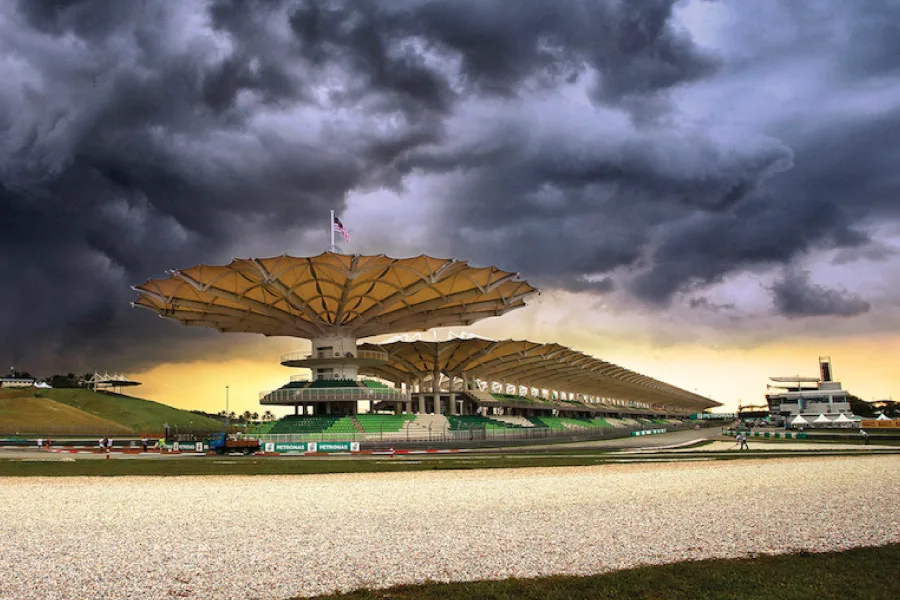
One of Sepang International Circuit’s most recognisable architectural features is the grandstand positioned between the circuit’s two long straights.
Its umbrella-like roof and central tower create a visual identity that is immediately associated with the venue. Spectators seated in this area can view action on both sides, including the approach towards the final corner and the acceleration zone leading towards the first turn.
The roof structures found throughout Sepang were designed not only to provide cover but also to give the venue a distinctive Malaysian and tropical character.
Even without racing cars or motorcycles on the track, the grandstand silhouette makes Sepang visually identifiable. That architectural identity is one of the reasons the circuit continues to stand apart from many newer motorsport facilities.
Racing in Malaysia’s Unpredictable Tropical Weather
Sepang’s weather is part of its character.
Competitors may face intense sunshine, high humidity and track temperatures before conditions change suddenly with the arrival of heavy tropical rain. The circuit’s climate has produced races in which tyre choices, pit-stop timing and visibility became just as important as outright speed.
Malaysia’s combination of heat and humidity also places significant physical demands on drivers and motorcycle riders. Cockpit temperatures can become exhausting, while dehydration and concentration become serious concerns during longer races.
These conditions have contributed to Sepang’s reputation as a demanding venue. A successful performance requires not only a fast vehicle but also adaptability, endurance and careful strategic judgement.
A Venue Closely Associated with MotoGP
Although Formula One left Sepang after the 2017 race, the circuit’s international motorsport identity continued through the Malaysian Motorcycle Grand Prix.
Sepang has hosted MotoGP since 1999, apart from interruptions during the pandemic period. It remains one of the championship’s established Asian venues and continues attracting a passionate regional audience.
Motorcycle racing arguably fits Sepang particularly well. The combination of fast corners, long straights and heavy braking zones creates opportunities for overtaking while testing tyre performance and rider control.
Malaysia also has a significant motorcycle culture, giving the event relevance beyond international visitors. Fans travel from across Malaysia and neighbouring countries to attend, creating one of the circuit’s most energetic annual weekends.
For many younger motorsport supporters, Sepang is now as closely associated with MotoGP as it is with its earlier Formula One era.
More Than a Formula One Circuit
One reason Sepang has remained important is its ability to host multiple categories of motorsport.
Beyond Formula One and MotoGP, the venue has accommodated endurance racing, touring cars, GT championships, Asian motorcycle competitions, local racing series, driver-development programmes and private track days.
The full circuit can also be divided into shorter North and South configurations, providing flexibility for different events and participant levels. The venue’s wider facilities support product launches, corporate events, training activities and non-racing functions.
This adaptability has helped Sepang avoid becoming a dormant monument to a previous Formula One era. It remains a working motorsport venue rather than simply a historical attraction.
Visitors interested in seeing it outside a major racing weekend can consult our complete Sepang International Circuit guide for current information about events, visitor access and experiences.
A Gateway for Malaysian Motorsport Talent
Sepang’s significance is not limited to international championships. It has also provided a home for Malaysian motorsport development.
Young drivers and riders can compete in support races, training programmes and domestic championships without immediately travelling overseas. Local mechanics, engineers, race officials, marshals and event professionals also gain experience working at an internationally recognised venue.
The circuit has helped expose Malaysian audiences to professional motorsport and supported a wider ecosystem involving racing teams, automotive companies, media, hospitality providers and technical personnel.
Its influence therefore extends beyond the spectators who attend major events. Sepang has contributed to the development of motorsport as an industry and sporting culture in Malaysia.
Its Role in the Growth of Asian Motorsport
Sepang arrived before the major expansion of Formula One across Asia and the Middle East.
When the Malaysian Grand Prix began in 1999, Japan was already an established Formula One destination, but many of the modern circuits now associated with the championship had yet to open.
Sepang demonstrated the potential of combining a major circuit with an international airport, modern highways and government-supported tourism development. Similar elements would later appear in other purpose-built motorsport destinations.
The circuit also helped make Southeast Asia a more important market for racing teams, sponsors and manufacturers. Its location allowed supporters from Singapore, Indonesia, Thailand and elsewhere in the region to attend a major international race without travelling to Europe or Australia.
While newer venues may offer greater luxury or more dramatic city-centre surroundings, Sepang remains historically important because it helped lead this period of Asian motorsport expansion.
A Circuit Remembered by Drivers and Racing Fans
A venue becomes iconic through more than architecture or statistics. It also needs memorable competition and emotional associations.
Across its Formula One years, Sepang hosted championship battles, unpredictable wet races, strategic surprises and victories involving some of the era’s most celebrated drivers. Its first Formula One race took place in 1999, while the final Malaysian Grand Prix of that period was staged in 2017.
MotoGP has added another layer to that history. Generations of motorcycle racing supporters associate Sepang with dramatic overtakes, intense heat, packed grandstands and pivotal late-season races.
The venue has also experienced tragedy, most notably the death of Italian MotoGP rider Marco Simoncelli following an accident during the 2011 Malaysian Motorcycle Grand Prix. The incident remains a deeply solemn part of Sepang’s history and the wider motorsport community’s memory.
These moments—celebratory and tragic—have given the circuit an emotional history that newer venues cannot manufacture instantly.
Its Strategic Location Near KLIA
Sepang International Circuit is located close to Kuala Lumpur International Airport, making it one of the region’s more accessible purpose-built racing venues.
International competitors, teams and spectators can arrive at KLIA and reach the circuit without first travelling through central Kuala Lumpur. The airport also connects with the capital through the KLIA Ekspres and KLIA Transit, while highways link Sepang with Putrajaya, Cyberjaya and other parts of the Klang Valley.
The airport location has practical advantages, but it also strengthens Sepang’s identity as Malaysia’s international gateway.
Visitors attending a race can stay at one of the best hotels in Sepang, many of which are concentrated around KLIA, KLIA Aeropolis and Kota Warisan. However, rooms and transport can become limited during major motorsport weekends, so early planning remains essential.
Why Formula One Fans Still Talk About Sepang
Even after Formula One stopped racing in Malaysia following the 2017 Grand Prix, Sepang never disappeared from discussions among fans.
The circuit’s layout was generally regarded as capable of producing competitive racing, while its unpredictable weather added an element that could not be controlled or reproduced artificially.
Its absence also coincided with growing debate about the character of newer circuits. As Formula One added more street races and entertainment-focused destinations, some supporters began looking back fondly at permanent circuits such as Sepang that offered broad run-off areas, high speeds and multiple overtaking possibilities.
Renewed discussion in 2026 regarding Malaysia potentially hosting a race again has further revived interest in Sepang. Reports indicated that the circuit was being considered as a possible replacement venue amid disruption elsewhere on the calendar, although arrangements were still developing at the time of writing.
Whether or not Formula One returns permanently, the strength of the reaction shows how much affection remains for the Malaysian venue.
How Sepang Compares with Other Iconic Asian Circuits
Asia is home to several internationally significant racing venues, but each has a different identity.
Sepang vs Suzuka
Suzuka is older and deeply associated with Formula One history, manufacturer Honda and championship-deciding races. Its figure-eight design is among the most distinctive in the world.
Sepang cannot match Suzuka’s longer heritage, but it represents a different era. It became a model for the large, modern, purpose-built international circuits that emerged around the turn of the century.
Sepang vs Marina Bay
Singapore’s Marina Bay Street Circuit is known for night racing, city views and a festival-like atmosphere.
Sepang offers a more traditional motorsport experience. It is a permanent track with faster sections, broader spaces and a layout designed primarily around racing rather than city streets.
Sepang vs Shanghai International Circuit
Both circuits were designed by Hermann Tilke and feature extensive facilities, long straights and large grandstands.
Sepang opened earlier and carries greater significance as one of the projects that established Tilke’s international reputation. Its tropical climate and connection to Southeast Asian motorcycle culture also give it a noticeably different character.
Sepang vs Buriram
Thailand’s Chang International Circuit has developed a strong MotoGP identity and enjoys enthusiastic local support.
Sepang has a longer international history and the additional prestige of having hosted Formula One for almost two decades. Together, the two venues demonstrate the strength of motorcycle-racing culture in Southeast Asia.
Can You Visit Sepang International Circuit?
Sepang International Circuit is not only accessible during MotoGP and other major race weekends. The venue hosts a changing programme of track days, automotive events, competitions, corporate functions and public activities.
Access to particular sections depends on the circuit’s schedule. Visitors should therefore check the official event calendar before travelling rather than assuming that grandstands, paddocks or track areas will be open.
The circuit is easiest to reach by car, taxi or e-hailing service. Public transport does not normally provide a direct, convenient connection to the entrance, although special transport arrangements may operate for major events.
Visitors can also combine the circuit with other things to do in Sepang, including shopping at Mitsui Outlet Park, exploring Sungai Pelek or watching the sunset at Bagan Lalang Beach.
What Is the Best Time to Visit?
The most exciting time to visit Sepang International Circuit is during a major racing event, especially MotoGP. This is when the grandstands, merchandise areas and surrounding precinct are at their liveliest.
Smaller racing events and track days offer a different advantage. Crowds are usually lighter, making it easier to explore the venue and focus on the racing itself.
Sepang is hot and humid throughout the year. Visitors should bring sun protection, stay hydrated and carry a lightweight raincoat or poncho because weather conditions can change rapidly.
Frequently Asked Questions
Why is Sepang International Circuit famous?
Sepang is famous for hosting the Malaysian Formula One Grand Prix from 1999 to 2017, staging MotoGP and introducing one of Asia’s earliest major purpose-built modern circuit complexes.
Who designed Sepang International Circuit?
The circuit was designed by German architect Hermann Tilke, who later designed several other prominent Formula One venues.
How long is the Sepang circuit?
The main Grand Prix layout is 5.543 kilometres long and includes 15 corners and eight straights.
Does Formula One still race at Sepang?
Malaysia’s last Formula One Grand Prix was held at Sepang in 2017. In July 2026, reports indicated that discussions were taking place about a potential return as part of a revised calendar, but readers should check the latest official announcement before planning a trip.
Does Sepang still host MotoGP?
Yes. Sepang remains the venue for the Malaysian Motorcycle Grand Prix and has been associated with MotoGP since 1999, apart from pandemic-related interruptions.
Is Sepang International Circuit near KLIA?
Yes. The circuit is located within the Sepang district near Kuala Lumpur International Airport. Travelling by road is generally the most practical option.
Can tourists enter Sepang International Circuit?
Access depends on the event schedule. Visitors can attend races, track events and selected activities, but general entry to particular areas is not guaranteed every day.
Is Sepang International Circuit worth visiting without Formula One?
Yes. MotoGP, endurance races, domestic competitions and track events continue to make Sepang an active venue. Its architecture and historical importance also appeal to dedicated motorsport fans.
Sepang International Circuit became iconic not simply because it hosted Formula One, but because it represented a turning point for motorsport in Malaysia and across Asia.
It combined ambitious architecture, a demanding layout, tropical conditions and major international events at a time when relatively few Asian destinations possessed comparable facilities. It introduced countless Malaysians to global motorsport, created an enduring home for MotoGP and helped establish a model followed by later purpose-built circuits.
Suzuka may possess a longer racing history, while Singapore offers a more dramatic urban spectacle. Yet Sepang holds a distinct place between them: a permanent, modern circuit that helped shift the geographical centre of international motorsport towards Asia.
That is why, more than 25 years after opening, Sepang International Circuit remains not only Malaysia’s leading motorsport venue, but one of Asia’s most recognisable racing landmarks.