
Long before the Petronas Twin Towers, KL Tower, and Merdeka 118 transformed Kuala Lumpur’s skyline, there was Dayabumi Complex.
Completed in 1984, the distinctive white tower was among the skyscrapers that defined Kuala Lumpur’s emergence as a modern capital during the 1980s. Its geometric Islamic-inspired façade made it unlike the conventional glass-and-concrete office towers appearing around many Asian cities at the time.
More than four decades later, Dayabumi remains instantly recognisable.
Standing along Jalan Sultan Hishamuddin beside Kuala Lumpur’s historic core, the tower creates an intriguing architectural dialogue with landmarks from different periods of the city’s development—from the old Kuala Lumpur Railway Station and Sultan Abdul Samad Building to the modern Merdeka 118 rising nearby.
If you’re interested in discovering Kuala Lumpur beyond its most famous tourist attractions, Dayabumi offers a fascinating glimpse into an important period when Malaysia was beginning to express a distinctly national identity through modern architecture.
What Is Dayabumi Complex?
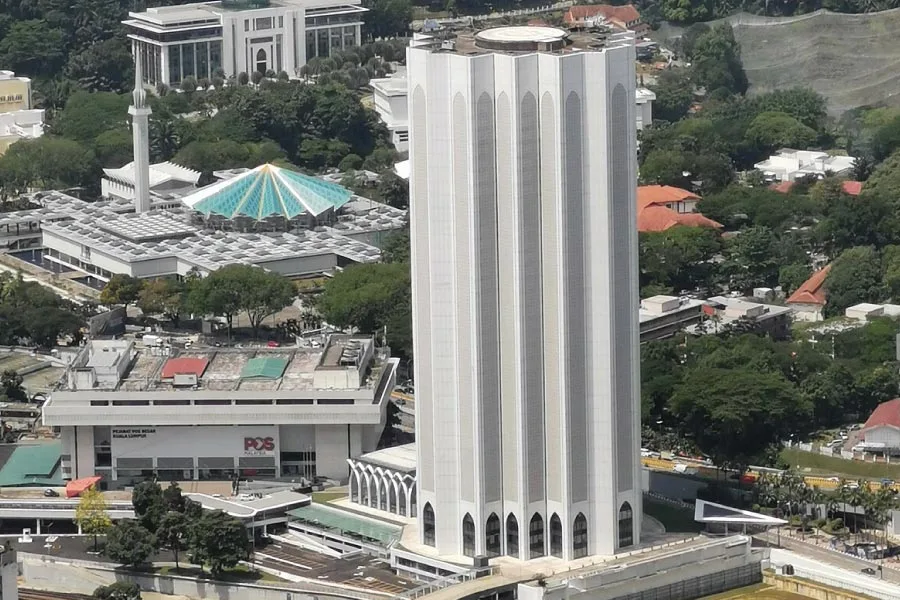
Dayabumi Complex, or Kompleks Dayabumi, is a landmark office complex located along Jalan Sultan Hishamuddin in central Kuala Lumpur.
Completed in 1984, its main tower rises approximately 157 metres and contains 36 storeys. It was developed by the Urban Development Authority (UDA) as part of a major urban renewal programme for central Kuala Lumpur.
The complex was designed through a collaboration between Malaysian architectural practice Arkitek MAA and BEP Akitek.
What immediately distinguishes Dayabumi is its architecture. Instead of simply following the International Style common among high-rise buildings of the era, its designers incorporated Islamic geometric forms and architectural references into the façade of a modern skyscraper.
The result became one of Kuala Lumpur’s most recognisable buildings of the 1980s.
The History of Dayabumi Complex
Before Dayabumi: A Railway Site
The story of Dayabumi begins long before the skyscraper was built.
The site was previously occupied by workshops and facilities belonging to the Malayan Railway. Its location was particularly strategic, sitting close to the historic Kuala Lumpur Railway Station and the railway administration building.
By the late twentieth century, Kuala Lumpur was expanding rapidly and parts of the old city centre were being considered for redevelopment.
UDA subsequently selected the area for a major urban renewal project that would eventually become Dayabumi Complex.
Construction Begins in the Early 1980s
Construction began in 1982, during a transformative period in Kuala Lumpur’s development.
Malaysia was pursuing rapid industrialisation and modernisation, while Kuala Lumpur was increasingly developing the skyline and infrastructure expected of a modern national capital.
Dayabumi became one of the most ambitious projects associated with this transformation.
Despite the scale of the development, construction progressed remarkably quickly. The complex was completed in February 1984 and officially opened on 5 May 1984 by Prime Minister Tun Dr Mahathir Mohamad.
At the time, the project reportedly cost around RM200 million.
Dayabumi and the Transformation of Kuala Lumpur
To understand why Dayabumi matters, it helps to look beyond the building itself.
Kuala Lumpur during the 1980s was undergoing an enormous transformation. New highways, commercial developments, office towers, and major public projects were reshaping a city that had previously been dominated by low-rise shophouses and colonial-era administrative buildings.
Dayabumi represented this new confidence.
It was modern and ambitious, yet its architects deliberately avoided creating a skyscraper that could have belonged to almost any international city.
Instead, Islamic architectural references were incorporated into a modern high-rise building, giving Dayabumi a distinctive identity connected to Malaysia.
It became an early example of the architectural search for a Malaysian expression of modernity—an idea that would continue influencing major developments across Kuala Lumpur in subsequent decades.
Visitors interested in how the city evolved can see another chapter of that story at Merdeka 118, where a twenty-first-century skyscraper now rises above the same historic part of Kuala Lumpur.
The Architecture of Dayabumi Complex
Architecture is arguably the main reason Dayabumi remains so distinctive today.
The building was designed by Arkitek MAA and BEP Akitek, combining modern high-rise construction with a strong Islamic architectural character.
Its architects described the design as a fusion of old and new that responded to surrounding landmarks including Masjid Negara, the Sultan Abdul Samad Building, and Kuala Lumpur’s historic railway buildings.
The Eight-Pointed Star Motifs
Look closely at the tower and one of its defining features becomes apparent: repeating geometric patterns based around the eight-pointed star.
Geometric patterns have played an important role in Islamic decorative arts for centuries, and at Dayabumi they were translated onto the enormous scale of a modern skyscraper.
Rather than being merely decorative additions, these patterns became part of the building’s visual identity.
The Islamic Arches
Large pointed and vaulted arches appear throughout the exterior composition, particularly around the upper and lower sections of the tower.
These architectural elements give the skyscraper a distinctly Islamic character despite its modern construction.
When seen alongside nearby Masjid Negara, the Islamic Arts Museum, and Kuala Lumpur Railway Station, Dayabumi contributes to an unusually diverse architectural landscape within this part of the city.
The White Façade
Another characteristic that makes Dayabumi immediately recognisable is its predominantly white exterior.
The tower was finished with white glass mosaic, allowing its intricate geometric patterns and openings to become particularly prominent when viewed from a distance.
Against Kuala Lumpur’s increasingly glass-dominated skyline, the white façade still gives Dayabumi an appearance quite unlike most modern office towers.
Why Dayabumi Complex Is Architecturally Important
Dayabumi represents an important moment in Malaysian architecture.
During the decades following independence, architects across Malaysia were increasingly asking what modern Malaysian architecture should look like.
Should buildings simply adopt the International Style being used throughout the world? Or could Malaysia develop modern architecture that reflected its own history, culture, climate, and identity?
Dayabumi was one response.
Rather than recreating a traditional building, its designers incorporated Islamic geometry and architectural references into the language of a modern skyscraper.
This approach would become increasingly visible in later Malaysian architecture, making Dayabumi an important landmark in understanding how the country’s architectural identity developed.
For architecture enthusiasts, it pairs particularly well with the nearby Sultan Abdul Samad Building, Kuala Lumpur Railway Station, and Masjid Negara, each representing a very different period and philosophy of Kuala Lumpur architecture.
Was Dayabumi Once Malaysia’s Tallest Building?
Yes. When completed in 1984, Dayabumi briefly became the tallest building in Malaysia.
At approximately 157 metres, its scale was extraordinary compared with much of Kuala Lumpur’s skyline at the time.
Its reign at the top was short-lived as taller buildings soon appeared, but its importance was never purely about height.
Throughout the 1980s and early 1990s, Dayabumi remained one of the defining visual landmarks of Kuala Lumpur.
Today it is dwarfed by skyscrapers such as the Petronas Twin Towers and Merdeka 118, but this contrast makes the building even more interesting. Together, these towers allow visitors to trace several generations of Kuala Lumpur’s skyscraper development within a relatively small area.
Dayabumi and Central Market
One particularly interesting chapter in the Dayabumi story involves nearby Central Market.
As plans for the larger Dayabumi development progressed, the historic market building faced an uncertain future amid the redevelopment of the surrounding area.
The development was eventually realigned, allowing Central Market to survive.
That decision proved extremely important for Kuala Lumpur’s heritage. Central Market was subsequently conserved and transformed into the arts, crafts, and cultural destination visitors know today.
The two buildings now stand within walking distance of each other—one representing Kuala Lumpur’s ambitious modernisation during the 1980s and the other demonstrating the value of preserving the city’s older architecture.
Can You Visit Dayabumi Complex?
Dayabumi is primarily a working commercial office complex rather than a conventional tourist attraction.
Visitors should therefore not expect observation decks, museum galleries, or organised sightseeing experiences inside the tower.
However, the building is easy to appreciate from the surrounding streets and public areas.
Architecture enthusiasts will find the exterior particularly interesting, while its location makes it an easy addition to a walking itinerary through Kuala Lumpur’s heritage centre.
For most travellers, Dayabumi is best experienced as an architectural landmark rather than a standalone attraction.
Best Places to View Dayabumi
From Jalan Sultan Hishamuddin
Viewing the tower from street level allows you to appreciate the scale of the façade and examine its geometric details more closely.
From Central Market
The area around Central Market provides another interesting perspective, particularly because it places two very different periods of Kuala Lumpur’s architectural history within the same urban landscape.
From the River of Life and Heritage Core
Exploring the wider River of Life and historic city centre provides opportunities to see Dayabumi appearing behind Kuala Lumpur’s older buildings.
These layered views—colonial architecture, post-independence skyscrapers, and twenty-first-century towers—are among the most interesting aspects of exploring central Kuala Lumpur.
Why Visit Dayabumi Complex?
An Icon of 1980s Kuala Lumpur
Dayabumi captures a period when Kuala Lumpur was rapidly reinventing itself as a modern international capital.
Although newer skyscrapers have surpassed it in height, few buildings tell the story of the city’s 1980s transformation as clearly.
One of Kuala Lumpur’s Most Distinctive Skyscrapers
Its white façade, eight-pointed geometric motifs, and enormous Islamic arches make Dayabumi unlike almost any other tower in Kuala Lumpur.
Architecture enthusiasts should take time to examine the details rather than simply viewing it from a distance.
Part of Kuala Lumpur’s Architectural Story
From the colonial-era Sultan Abdul Samad Building to Dayabumi, the Petronas Twin Towers and today’s Merdeka 118, Kuala Lumpur’s architecture reveals how the ambitions and identity of the city have changed over time.
Dayabumi represents an essential chapter in that story.
Easy to Include in a Heritage Walk
Perhaps the best reason for travellers to seek out Dayabumi is its location.
The building sits close to some of the most important historical landmarks in Kuala Lumpur, meaning you don’t need to make a dedicated trip simply to see it.
Nearby Attractions to Combine with Dayabumi
Central Market
Just a short walk from Dayabumi, Central Market Kuala Lumpur began as a wet market before evolving into today’s arts and cultural destination. Its preserved Art Deco building provides an interesting architectural contrast with Dayabumi.
Petaling Street
Continue into Petaling Street and Kuala Lumpur’s Chinatown, where historic shophouses, temples, cafés, markets, and restaurants reveal another layer of the city’s multicultural history.
River of Life
The River of Life surrounds the historic confluence of the Klang and Gombak rivers, closely associated with Kuala Lumpur’s beginnings. Its riverside walk provides excellent perspectives of several surrounding landmarks.
Masjid Jamek
Located at the meeting point of the Klang and Gombak rivers, Masjid Jamek is one of Kuala Lumpur’s oldest mosques and a beautiful example of early twentieth-century architecture.
Merdeka Square
A short distance away, Merdeka Square forms the heart of Kuala Lumpur’s colonial civic district and is surrounded by some of Malaysia’s most historically significant buildings.
Sultan Abdul Samad Building
Facing Merdeka Square, the Sultan Abdul Samad Building is one of Kuala Lumpur’s most recognisable heritage landmarks. Its nineteenth-century architecture creates a fascinating comparison with Dayabumi’s interpretation of Islamic-inspired modernism.
Kuala Lumpur Railway Station
The historic Kuala Lumpur Railway Station is another architectural highlight nearby. Its distinctive arches, domes, and towers make it one of the most unusual railway buildings in Southeast Asia.
National Mosque
A short walk beyond the railway station brings you to Masjid Negara, Malaysia’s National Mosque. Completed in the 1960s, its modernist interpretation of Islamic architecture makes it particularly interesting to compare with Dayabumi.
A Kuala Lumpur Architecture Walk Around Dayabumi
Dayabumi’s location makes it possible to experience more than a century of Kuala Lumpur architecture within a single walk.
Begin around Merdeka Square and admire the Sultan Abdul Samad Building before continuing towards Masjid Jamek and the River of Life.
From there, walk towards Central Market and look for Dayabumi rising above the surrounding historic streets.
Continue past Dayabumi towards Kuala Lumpur Railway Station and Masjid Negara.
Within a relatively compact area, you’ll encounter colonial architecture, Art Deco influences, modernist Islamic architecture, 1980s skyscraper design, and views towards contemporary towers such as Merdeka 118.
For architecture and history enthusiasts, this is one of the most rewarding walks in Kuala Lumpur.
How to Get to Dayabumi Complex
By MRT or LRT
Pasar Seni Station is the most convenient rail station for most visitors. It is served by both the MRT Kajang Line and LRT Kelana Jaya Line.
From the station, Dayabumi is only a short walk away.
Our Kuala Lumpur MRT, LRT and Monorail guide explains the wider rail network if you’re travelling from elsewhere in the city.
By KTM
The historic Kuala Lumpur railway station is also nearby and is served by KTM Komuter services.
By Grab or Taxi
Grab and taxis can drop visitors near the complex, although using rail is often easier when exploring this busy part of central Kuala Lumpur.
Best Time to Visit Dayabumi
Dayabumi can be viewed throughout the day, but morning and late afternoon generally provide more comfortable conditions for walking around the surrounding heritage district.
Late afternoon is particularly rewarding for photography as changing sunlight emphasises the building’s white façade and geometric details.
Consider allowing several hours rather than visiting Dayabumi alone. Combining it with Central Market, Petaling Street, River of Life, and Merdeka Square creates a much more complete experience.
Dayabumi Complex FAQs
When was Dayabumi Complex built?
Construction began in 1982 and the complex was completed in 1984. It was officially opened on 5 May 1984.
How tall is Dayabumi Complex?
The main Dayabumi tower stands approximately 157 metres tall and contains 36 storeys.
Who designed Dayabumi Complex?
Dayabumi was designed through a collaboration between Arkitek MAA and BEP Akitek.
Why is Dayabumi famous?
Dayabumi is famous for being one of Kuala Lumpur’s earliest major skyscrapers and for its distinctive modern Islamic architecture featuring geometric star patterns, arches, and a white façade.
Was Dayabumi once the tallest building in Malaysia?
Yes. Upon completion in 1984, Dayabumi briefly held the distinction of being Malaysia’s tallest building before being surpassed by subsequent developments.
Can tourists enter Dayabumi Complex?
Dayabumi primarily functions as a commercial office complex rather than a tourist attraction. Visitors can appreciate its architecture from surrounding public areas, but there is no conventional observation deck or sightseeing experience inside.
What is the nearest train station to Dayabumi?
Pasar Seni is one of the most convenient stations, providing connections through the MRT Kajang Line and LRT Kelana Jaya Line.
What attractions are near Dayabumi?
Nearby attractions include Central Market, Petaling Street, River of Life, Masjid Jamek, Merdeka Square, Sultan Abdul Samad Building, Kuala Lumpur Railway Station, and Masjid Negara.
Is Dayabumi Complex Worth Seeing?
Dayabumi probably won’t occupy several hours of your Kuala Lumpur itinerary—and that’s not really the point.
Its value comes from understanding what the building represents.
Dayabumi captures an important moment when Kuala Lumpur was transforming into a modern capital and Malaysian architects were exploring how modern skyscrapers could express a local and Islamic architectural identity.
More than 40 years later, its distinctive white façade still stands out among Kuala Lumpur’s increasingly dense skyline.
Combined with nearby Central Market, Petaling Street, Merdeka Square, and the River of Life, Dayabumi becomes an important stop for anyone interested in understanding how Kuala Lumpur grew from a colonial-era town into the modern metropolis it is today.