Getting around Kuala Lumpur is easier than you might expect, even if you’re visiting Malaysia’s capital for the first time. With an extensive network of MRT and LRT trains, the KL Monorail, KTM Komuter, public buses and ride-hailing services such as Grab, you can explore much of the city without renting a car.
However, Kuala Lumpur is a sprawling city. Popular destinations such as the Petronas Twin Towers, Bukit Bintang, Chinatown, Bangsar and Batu Caves are spread across different neighbourhoods, and not every attraction is within walking distance of a train station.
The secret to travelling around Kuala Lumpur efficiently is knowing when to take the train, when to walk and when to use Grab.
For most visitors, the best approach is to use MRT and LRT trains for longer journeys, walk around compact neighbourhoods and take Grab for places that are difficult to reach by public transport.
This complete guide covers everything you need to know about transportation in Kuala Lumpur, including train lines, buses, fares, payment methods, airport transfers, useful interchange stations and the best ways to reach the city’s major attractions.
Quick Guide: What’s the Best Way to Get Around Kuala Lumpur?
If you’re visiting Kuala Lumpur for the first time, here’s a quick comparison of your main transport options.
| Transport | Best For | Things to Consider |
|---|---|---|
| MRT | Bukit Bintang, Chinatown, TRX, Cheras, Putrajaya | Fast and avoids road congestion |
| LRT | KLCC, KL Sentral, Bangsar, Masjid Jamek, Bukit Jalil | Extensive routes and useful interchanges |
| KL Monorail | Bukit Bintang, Imbi, Chow Kit | Convenient city-centre connections |
| KTM Komuter | Batu Caves and selected suburbs | Less frequent than many urban rail services |
| Rapid KL buses | Neighbourhoods beyond train stations | Affected by road traffic |
| GoKL buses | Selected central KL corridors | Routes and eligibility should be checked |
| Grab | Door-to-door trips, luggage, late evenings | Prices and waiting times vary |
| Walking | KLCC, Bukit Bintang, Chinatown | Heat, rain and uneven pedestrian infrastructure |
| Rental car | Outskirts and multi-stop trips outside KL | Traffic, tolls and parking |
| KL Hop-On Hop-Off | Sightseeing and city orientation | Slower during congestion |
Our recommendation: Use trains as the backbone of your journey, Grab for the final stretch and walking to explore individual neighbourhoods.
If you’re still planning your itinerary, our Kuala Lumpur Travel Guide is a useful starting point for understanding the city.
Understanding Kuala Lumpur’s Transport System
Kuala Lumpur has one of Southeast Asia’s more extensive urban rail networks, but understanding the different services can initially seem confusing.
The city is served by several rail systems operated by different organisations, with trains connecting central Kuala Lumpur to surrounding areas across the Klang Valley.
The main services include:
- MRT: High-capacity trains serving central Kuala Lumpur and major suburban corridors.
- LRT: Urban trains connecting commercial districts, residential areas and transport hubs.
- KL Monorail: A shorter elevated route through central Kuala Lumpur.
- KTM Komuter: Suburban trains connecting Kuala Lumpur with destinations farther across the Klang Valley.
- KLIA Ekspres and KLIA Transit: Airport rail services connecting Kuala Lumpur with KLIA.
- KTM ETS: Intercity trains connecting Kuala Lumpur with destinations across Peninsular Malaysia.
The rail systems are supported by public buses, feeder buses, taxis and ride-hailing services.
While the network is integrated through interchange stations, not every service uses the same ticketing system or fare structure.
For a closer look at urban transport, read our dedicated Public Transport in Kuala Lumpur Guide.
Kuala Lumpur Transport Map: How to Read the Rail Network
The easiest way to understand Kuala Lumpur’s transport map is to identify a few important lines and stations rather than memorising the entire network.
For most tourists, the most useful rail routes are:
| Rail Line | Useful Destinations |
|---|---|
| MRT Kajang Line | Muzium Negara, Pasar Seni, Merdeka, Bukit Bintang, TRX |
| MRT Putrajaya Line | Titiwangsa, Ampang Park, Persiaran KLCC, TRX, Putrajaya |
| LRT Kelana Jaya Line | KLCC, Masjid Jamek, Pasar Seni, KL Sentral, Bangsar |
| LRT Ampang Line | Titiwangsa, Masjid Jamek, Hang Tuah, Maluri |
| LRT Sri Petaling Line | Masjid Jamek, Bandar Tasik Selatan, Bukit Jalil, Puchong |
| KL Monorail | KL Sentral, Imbi, Bukit Bintang, Chow Kit, Titiwangsa |
| KTM Komuter | Batu Caves, Bank Negara, KL Sentral, Mid Valley and selected suburbs |
The MRT Kajang and Putrajaya Lines are especially useful for travelling across central Kuala Lumpur, while the Kelana Jaya LRT Line provides direct access to KLCC and KL Sentral.
Before travelling, consult the official Rapid KL Integrated Transit Map for an overview of the rail network.
1. Getting Around Kuala Lumpur by MRT
The Mass Rapid Transit (MRT) system is one of the most convenient ways to travel around Kuala Lumpur.
MRT trains operate on dedicated tracks, avoiding road congestion and providing connections between major residential, commercial and tourist areas.
Kuala Lumpur has two operational MRT lines:
MRT Kajang Line
The Kajang Line connects Kwasa Damansara with Kajang, passing through Kota Damansara, Bandar Utama, TTDI, Muzium Negara, Pasar Seni, Merdeka, Bukit Bintang, TRX and Cheras.
It is particularly useful for visiting:
- Chinatown and Central Market
- Bukit Bintang
- The Exchange TRX
- Merdeka 118 precinct
- National Museum
- MyTOWN Shopping Centre
- Bandar Utama and 1 Utama Shopping Centre
For a complete station list and interchange information, read our MRT Kajang Line Guide.
MRT Putrajaya Line
The Putrajaya Line connects Kwasa Damansara with Putrajaya Sentral.
It serves Kepong, Titiwangsa, Hospital Kuala Lumpur, Ampang Park, Persiaran KLCC, Conlay, TRX, Serdang, Cyberjaya and Putrajaya.
This line is useful for:
- The KLCC area
- The Exchange TRX
- Titiwangsa
- Hospital Kuala Lumpur
- Cyberjaya
- Putrajaya
The two MRT lines intersect at TRX and Kwasa Damansara.
For most journeys within central Kuala Lumpur, TRX is the more convenient interchange.
Explore our MRT Kuala Lumpur Guide and MRT Putrajaya Line Guide for detailed route information.
2. Getting Around Kuala Lumpur by LRT
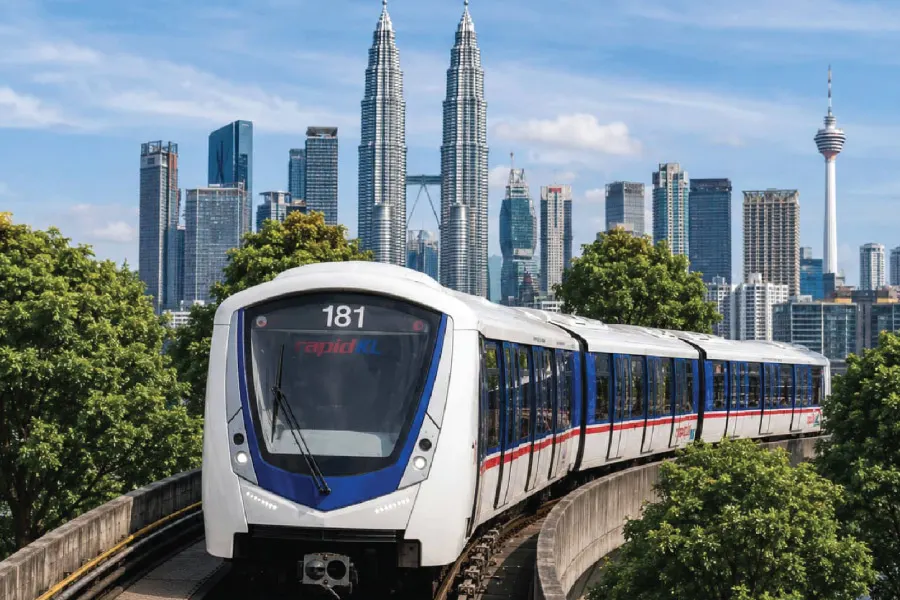
The Light Rail Transit (LRT) network is another important part of Kuala Lumpur’s public transport system.
It connects the city centre with residential and commercial areas across the Klang Valley.
The established LRT services are the Kelana Jaya, Ampang and Sri Petaling Lines, with the newer Shah Alam Line (LRT3) expanding connectivity across the western Klang Valley. Check the latest operating status of LRT3 before planning a journey.
LRT Kelana Jaya Line
The Kelana Jaya Line runs between Gombak and Putra Heights.
It serves several important locations:
- KLCC
- Kampung Baru
- Masjid Jamek
- Pasar Seni
- KL Sentral
- Bangsar
- Petaling Jaya
- Subang Jaya
For tourists, this is one of the most useful LRT lines because it connects the Petronas Twin Towers with KL Sentral and the historic city centre.
LRT Ampang Line
The Ampang Line connects Sentul Timur with Ampang.
Useful stations include Titiwangsa, Masjid Jamek, Plaza Rakyat, Hang Tuah, Chan Sow Lin and Maluri.
LRT Sri Petaling Line
The Sri Petaling Line connects Sentul Timur with Putra Heights.
It is particularly useful for travelling to:
- Terminal Bersepadu Selatan
- Bukit Jalil National Stadium
- Sri Petaling
- Puchong
- Putra Heights
The Ampang and Sri Petaling Lines share tracks through central Kuala Lumpur before separating at Chan Sow Lin. Always check the train’s destination before boarding.
LRT Shah Alam Line (LRT3)
The LRT Shah Alam Line (LRT3) is the newest addition to the Klang Valley’s light rail network, designed to improve public transport connectivity between Bandar Utama, Shah Alam, Klang and Johan Setia.
Unlike the Kelana Jaya, Ampang and Sri Petaling Lines, which serve established corridors through Kuala Lumpur, the Shah Alam Line focuses on the western Klang Valley, connecting residential neighbourhoods, commercial centres, universities and major employment areas.
The line stretches approximately 37.8 kilometres between Bandar Utama and Johan Setia, with 20 stations planned for the initial operating phase and additional provisional stations.
Major areas along the route include:
- Bandar Utama
- Tropicana
- Glenmarie
- Shah Alam
- UiTM Shah Alam
- Klang
- Bandar Bukit Tinggi
- Johan Setia
Our LRT Kuala Lumpur Guide explains the entire network, while the LRT Kelana Jaya Line, LRT Ampang & Sri Petaling Line and LRT Shah Alam Line (LRT3) articles provide detailed route information.
3. Getting Around Central Kuala Lumpur by Monorail
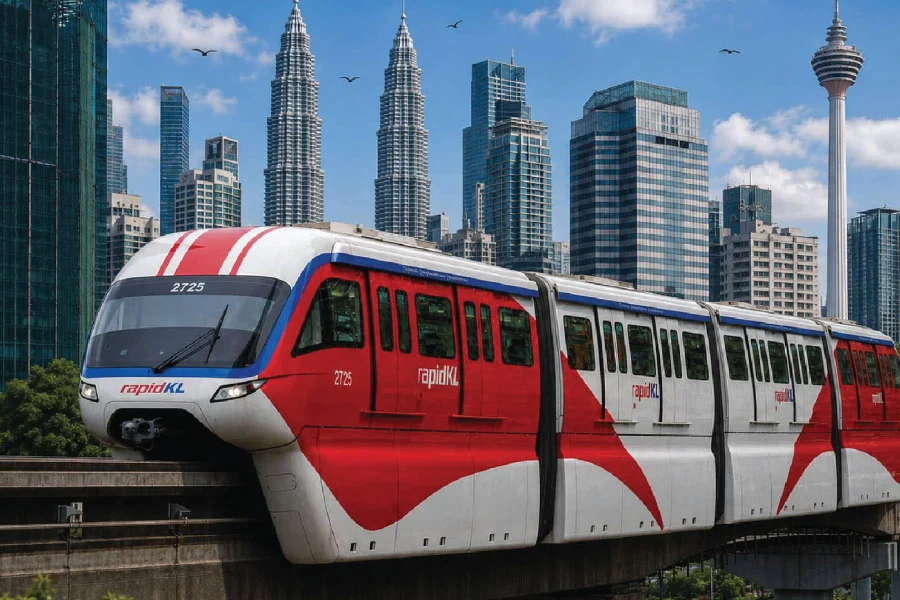
The KL Monorail is a shorter elevated railway connecting several important areas of central Kuala Lumpur.
It runs between KL Sentral and Titiwangsa, passing through shopping, entertainment and commercial districts.
Important stops include:
- KL Sentral
- Maharajalela
- Hang Tuah
- Imbi
- Bukit Bintang
- Raja Chulan
- Bukit Nanas
- Medan Tuanku
- Chow Kit
- Titiwangsa
The Monorail is particularly convenient for travellers staying around Bukit Bintang, Imbi and Chow Kit.
It also provides useful interchange connections with the LRT and MRT networks.
However, the Monorail is not always the fastest option for longer journeys. Depending on your destination, an MRT or LRT route may be more direct.
Read our KL Monorail Guide for the complete route and station information.
4. KTM Komuter: Best for Batu Caves and Suburban Travel
KTM Komuter is a suburban railway service operated by KTMB.
Unlike MRT and LRT services, which focus on frequent urban travel, KTM Komuter connects Kuala Lumpur with destinations farther across the Klang Valley.
For tourists, one of its most important routes is the service to Batu Caves.
Batu Caves is a major Hindu religious site and one of the Klang Valley’s most popular attractions.
Visitors can take KTM Komuter to Batu Caves station, located near the temple complex.
Other KTM Komuter destinations include selected stations in areas such as Rawang, Seremban, Shah Alam and Port Klang.
Train frequencies can be lower than those of the MRT and LRT, so checking the timetable is especially important.
What About KTM ETS?
KTM ETS is different from KTM Komuter.
ETS is an intercity railway service connecting Kuala Lumpur with destinations such as Ipoh, Butterworth, Padang Besar and Johor Bahru.
If you’re travelling beyond the Klang Valley, read our KTM ETS Guide for routes, fares, booking information and journey times.
5. Important Train Interchange Stations in Kuala Lumpur
Understanding a few major interchange stations can make navigating Kuala Lumpur much easier.
| Station | Main Connections | Useful For |
|---|---|---|
| KL Sentral | LRT, KTM, airport rail, nearby MRT and Monorail | Airport transfers, intercity travel |
| Pasar Seni | MRT Kajang, LRT Kelana Jaya | Chinatown, Central Market |
| Masjid Jamek | LRT Kelana Jaya, Ampang, Sri Petaling | Historic city centre |
| TRX | MRT Kajang, MRT Putrajaya | Shopping, MRT transfers |
| Titiwangsa | MRT Putrajaya, LRT Ampang/Sri Petaling, Monorail | Northern city connections |
| Hang Tuah | LRT Ampang/Sri Petaling, Monorail | Berjaya Times Square |
| Maluri | MRT Kajang, LRT Ampang | Sunway Velocity |
| Chan Sow Lin | MRT Putrajaya, LRT Ampang/Sri Petaling | Cross-network transfers |
| Bandar Tasik Selatan | LRT Sri Petaling, KTM, KLIA Transit | TBS bus terminal, airport |
| Putra Heights | LRT Kelana Jaya, Sri Petaling | Suburban connections |
KL Sentral: Kuala Lumpur’s Main Transport Hub
KL Sentral is the city’s principal railway hub.
It connects multiple services, including the Kelana Jaya LRT Line, KTM Komuter, KTM ETS, KLIA Ekspres and KLIA Transit.
Two additional connections require short walks:
- MRT Kajang Line: Use Muzium Negara station and the covered pedestrian walkway.
- KL Monorail: Walk through NU Sentral towards the Monorail station.
These are not same-platform transfers.
Our KL Sentral Guide explains the layout and connections in greater detail.
Pasar Seni: The Gateway to Chinatown
Pasar Seni connects the MRT Kajang Line and LRT Kelana Jaya Line.
It is also one of the most convenient stations for visiting Chinatown, Petaling Street and Central Market.
TRX: The MRT Interchange
Tun Razak Exchange connects the MRT Kajang and Putrajaya Lines.
It also provides direct access to The Exchange TRX shopping mall.
Masjid Jamek: The LRT Interchange
Masjid Jamek connects the Kelana Jaya Line with the Ampang and Sri Petaling Lines.
It is located close to Merdeka Square and several historic landmarks.
6. Getting Around Kuala Lumpur by Bus

Kuala Lumpur has an extensive public bus network, although buses can be less predictable than trains because they share the road with other vehicles.
For visitors, buses are particularly useful when travelling to destinations not directly served by MRT or LRT stations.
Rapid KL Buses
Rapid KL operates bus services across Kuala Lumpur and the surrounding Klang Valley.
These routes connect:
- Residential neighbourhoods
- Commercial districts
- Train stations
- Shopping centres
- Schools and universities
- Suburban transport hubs
Many MRT and LRT stations are also served by feeder buses that connect surrounding neighbourhoods to the railway network.
Buses can be an economical option, but travel times depend heavily on traffic conditions.
For detailed information, see our Kuala Lumpur Bus Guide.
GoKL City Buses
GoKL buses operate selected routes around Kuala Lumpur, including central business and visitor districts.
They can be useful for short journeys between areas not conveniently connected by rail.
However, GoKL should not automatically be treated as free for every passenger. Fare rules, eligibility, payment requirements and routes may change.
Check the latest official GoKL information before travelling.
KL Hop-On Hop-Off Bus
The KL Hop-On Hop-Off service is primarily designed for sightseeing.
It travels between selected tourist attractions and allows passengers to explore the city using designated stops.
This can be a convenient way to see Kuala Lumpur’s landmarks without planning individual public transport routes.
However, because the buses travel on public roads, traffic congestion can affect journey times.
For most visitors, the Hop-On Hop-Off bus is better suited to a sightseeing day than everyday transport.
7. Using Grab and Taxis in Kuala Lumpur
Grab is one of the most convenient ways to travel around Kuala Lumpur, particularly when a destination is not close to a train station.
Grab is a ride-hailing application that allows passengers to book cars through their smartphones.
Before confirming a ride, the app normally displays an estimated fare and pick-up details.
When Is Grab the Best Option?
Grab is particularly useful when:
- Travelling with luggage
- Visiting restaurants away from train stations
- Returning to your hotel late at night
- Travelling with children or elderly family members
- Visiting areas with limited public transport
- Travelling as a group
For short journeys involving several passengers, Grab can sometimes be competitive with public transport.
However, fares fluctuate with demand, and road congestion can make even short journeys surprisingly slow.
When Should You Avoid Grab?
During weekday peak hours, taking a train is often more predictable.
Traffic congestion can be particularly heavy around:
- KLCC
- Bukit Bintang
- Jalan Tun Razak
- Jalan Sultan Ismail
- Major highways entering the city
- Large event venues
If your destination is close to a rail station, the train may save considerable time.
Traditional Taxis
Traditional metered taxis remain available in Kuala Lumpur.
They can be found at hotels, transport hubs, shopping centres and selected taxi stands.
Use licensed taxi services and confirm the fare arrangement before travelling.
8. Walking Around Kuala Lumpur
Walking is one of the best ways to explore certain parts of Kuala Lumpur, but the city is not equally pedestrian-friendly everywhere.
Some neighbourhoods have well-developed pedestrian infrastructure, while others are divided by busy roads and highways.
The tropical climate is another important consideration.
Kuala Lumpur is hot and humid throughout the year, with frequent afternoon rain.
Best Areas to Explore on Foot
Bukit Bintang
Bukit Bintang is one of the most walkable visitor districts.
Major shopping centres, restaurants, hotels and nightlife destinations are concentrated within a relatively compact area.
Popular stops include Pavilion Kuala Lumpur, Lot 10, Fahrenheit88, Jalan Alor and Changkat Bukit Bintang.
Read our Bukit Bintang Guide for attractions, dining and neighbourhood information.
KLCC
The KLCC precinct has pedestrian paths, shopping mall connections and landscaped public spaces.
Visitors can explore Suria KLCC, KLCC Park, the Petronas Twin Towers and nearby attractions on foot.
Chinatown
Chinatown is particularly rewarding for walking.
The neighbourhood is filled with traditional shophouses, temples, markets, cafés and heritage landmarks.
Our Petaling Street Guide is a useful companion for exploring the area.
Merdeka Square and the Historic City Centre
The area around Merdeka Square, Masjid Jamek and the Sultan Abdul Samad Building is well suited to a heritage walk.
Many attractions are relatively close together, although visitors should remain mindful of traffic crossings and weather conditions.
The KLCC–Bukit Bintang Pedestrian Walkway
One of Kuala Lumpur’s most useful pedestrian connections is the covered, air-conditioned walkway linking the Pavilion Kuala Lumpur area with the Kuala Lumpur Convention Centre precinct.
It provides a convenient route between Bukit Bintang and the KLCC area.
From the Convention Centre, visitors can continue towards Suria KLCC and the Petronas Twin Towers.
The walkway is particularly helpful during hot or rainy weather, although access hours and connecting routes should be checked.
When Walking Is Not Practical
Avoid assuming that two destinations are easy to walk between simply because they appear close on a map.
Large roads, construction sites, pedestrian barriers and limited crossings can make certain journeys longer than expected.
9. How to Get from KLIA to Kuala Lumpur City Centre
Kuala Lumpur International Airport is located in Sepang, well outside Kuala Lumpur city centre.
Visitors arriving at KLIA have several options for reaching their accommodation.
| Transport | Best For | Main Consideration |
|---|---|---|
| KLIA Ekspres | Fast journey to KL Sentral | Requires onward transfer for many hotels |
| KLIA Transit | Airport rail with intermediate stops | Slower than the nonstop Ekspres |
| Airport bus | Budget-conscious travellers | Road traffic affects travel time |
| Grab or taxi | Door-to-door hotel transfer | Price varies with traffic and demand |
| Private transfer | Groups or prearranged arrivals | Usually requires advance booking |
KLIA Ekspres
KLIA Ekspres provides a direct rail connection between Kuala Lumpur International Airport and KL Sentral.
The journey from KLIA Terminal 1 to KL Sentral takes approximately 28 minutes, with Terminal 2 requiring additional travel time.
Once at KL Sentral, passengers can transfer to LRT, KTM, Monorail or the MRT Kajang Line via Muzium Negara.
KLIA Transit
KLIA Transit follows the airport railway corridor but stops at intermediate stations including Bandar Tasik Selatan, Putrajaya & Cyberjaya and Salak Tinggi.
It can be useful for travellers whose destinations are closer to these stations.
Grab or Airport Taxi
Grab and airport taxis provide direct journeys to hotels and other destinations.
They are particularly convenient for families, groups and travellers with substantial luggage.
For detailed instructions, read our KL Airport to City Guide and KLIA Express vs KLIA Transit Guide.
10. How to Pay for Public Transport in Kuala Lumpur
Understanding the different payment methods can make your journey smoother.
Touch ‘n Go Card
A physical Touch ‘n Go card is one of the most convenient ways to pay for Rapid KL rail journeys.
It is widely used on MRT, LRT, Monorail and participating bus services.
Passengers tap the card at the entrance and exit gates, with the appropriate fare deducted.
Keep sufficient stored value on your card before travelling.
Important: A Touch ‘n Go eWallet balance is not automatically interchangeable with the stored value on every physical Touch ‘n Go card. Check which card and payment methods are supported before boarding.
Single-Journey Tokens
Visitors making only a few rail journeys can purchase single-journey tokens at MRT and LRT ticket machines.
Select your destination, pay the fare and use the token at the entry and exit gates according to station instructions.
Rapid KL Travel Passes
Rapid KL offers travel passes for eligible passengers.
Depending on the product, these may provide unlimited journeys on selected services for a specified period.
Check the current pass price, validity and eligibility before purchasing.
Some passes are restricted to Malaysian citizens or particular passenger categories.
Can You Use Credit Cards Directly at Train Gates?
Do not assume that every Kuala Lumpur rail station accepts contactless bank cards directly at its fare gates.
Payment acceptance varies by operator and service.
For Rapid KL journeys, a physical Touch ‘n Go card or an appropriate ticket remains a practical option.
Airport rail and KTM services use their own ticketing arrangements.
11. How Much Does Transportation Cost in Kuala Lumpur?
Transportation costs depend on the distance, service and number of journeys.
In general:
- MRT and LRT: Affordable for everyday city travel, with distance-based fares.
- Monorail: Suitable for shorter city-centre journeys.
- KTM Komuter: Fares depend on the journey and route.
- Rapid KL buses: Economical for local and feeder journeys.
- Grab: Variable pricing based on distance, demand and traffic.
- Airport trains: More expensive than ordinary urban rail services.
- Sightseeing buses: Separate tourist-oriented ticket prices.
For visitors making several rail journeys a day, a suitable travel pass may offer better value than buying individual tickets.
However, there is no need to buy a pass automatically.
If you expect to spend most of the day walking around a single neighbourhood, individual tickets may be sufficient.
Use official fare calculators and booking platforms for current prices.
12. How to Get to Kuala Lumpur’s Popular Attractions
Knowing the nearest station can save considerable time when planning your itinerary.
| Destination | Recommended Station | Transport |
|---|---|---|
| Petronas Twin Towers | KLCC | LRT Kelana Jaya |
| Suria KLCC | KLCC | LRT Kelana Jaya |
| KLCC Park | KLCC / Persiaran KLCC | LRT / MRT |
| Pavilion Kuala Lumpur | Bukit Bintang | MRT Kajang / Monorail |
| Jalan Alor | Bukit Bintang | MRT Kajang / Monorail |
| The Exchange TRX | TRX | MRT Kajang / Putrajaya |
| Chinatown | Pasar Seni | MRT Kajang / LRT Kelana Jaya |
| Central Market | Pasar Seni | MRT Kajang / LRT Kelana Jaya |
| Merdeka Square | Masjid Jamek | LRT |
| Merdeka 118 precinct | Merdeka | MRT Kajang |
| National Museum | Muzium Negara | MRT Kajang |
| Batu Caves | Batu Caves | KTM Komuter |
| Bukit Jalil National Stadium | Bukit Jalil | LRT Sri Petaling |
| Berjaya Times Square | Imbi / Hang Tuah | Monorail / LRT |
| Sunway Velocity Mall | Maluri | MRT Kajang / LRT Ampang |
| MyTOWN Shopping Centre | Cochrane | MRT Kajang |
| 1 Utama Shopping Centre | Bandar Utama | MRT Kajang |
For places farther from stations, a short walk, bus journey or Grab ride may still be necessary.
13. Getting Around Kuala Lumpur from Popular Neighbourhoods
Where you stay can make a considerable difference to how easily you travel around Kuala Lumpur.
Staying in KLCC
KLCC is one of the most convenient areas for visitors who want to stay close to major attractions, shopping and international hotels.
Useful transport options include:
- Kelana Jaya LRT Line at KLCC
- MRT Putrajaya Line at Persiaran KLCC or Ampang Park
- Walking around the KLCC precinct
- Grab for destinations farther away
Read our Where to Stay in KLCC Guide for accommodation and neighbourhood advice.
Staying in Bukit Bintang
Bukit Bintang is particularly convenient for shopping, nightlife and restaurants.
The main public transport options are:
- MRT Kajang Line
- KL Monorail
- Walking
- Grab
The Bukit Bintang MRT and Monorail stations are separate facilities connected by a short pedestrian walk.
Our Where to Stay in Bukit Bintang Guide explores accommodation options around the district.
Staying in Chinatown
Chinatown is a practical base for travellers interested in heritage attractions, local food and older parts of Kuala Lumpur.
Pasar Seni station connects the MRT Kajang Line and Kelana Jaya LRT Line.
Merdeka MRT station is also useful for the southern side of the neighbourhood.
Explore our Petaling Street Guide for more information.
Staying in KL Sentral and Brickfields
KL Sentral is especially convenient for travellers arriving from the airport or planning intercity journeys.
It offers direct access to several railway services and is a practical base for exploring different parts of Kuala Lumpur.
Brickfields, also known for Little India, is within walking distance of the transport hub.
Staying in Bangsar
Bangsar offers restaurants, cafés, shopping and established residential surroundings.
The Kelana Jaya LRT Line serves Bangsar station, although many popular dining areas require additional transport.
Grab is particularly useful for travelling around Bangsar.
Read our Bangsar Neighbourhood Guide for more information.
14. Is Driving in Kuala Lumpur a Good Idea?
For most first-time visitors staying in central Kuala Lumpur, renting a car is unnecessary.
The city has extensive rail services, while Grab provides convenient door-to-door transport.
Driving can be challenging because of:
- Heavy traffic congestion
- Complex highway interchanges
- Toll roads
- One-way streets
- Limited parking at certain destinations
- Expensive parking in some commercial districts
However, renting a car can be useful if you’re planning to explore destinations outside central Kuala Lumpur or make several stops in areas with limited public transport.
For more information, read our Driving in Kuala Lumpur Guide.
15. Best Way to Get Around Kuala Lumpur at Night
Kuala Lumpur has an active nightlife scene, particularly around Bukit Bintang, Changkat Bukit Bintang, KLCC and selected neighbourhoods.
MRT, LRT and Monorail services generally begin around 6:00am and operate until late evening, but last-train times differ by station and direction.
If you’re planning to stay out late, check the final train before leaving your hotel.
Grab is often the more convenient option after rail services have ended.
When booking a ride late at night, choose a well-lit and clearly identifiable pick-up point, particularly around crowded entertainment districts.
16. Getting Around Kuala Lumpur with Children, Elderly Travellers or Luggage
Travelling with children, older family members or large suitcases requires additional planning.
Travelling with Children
MRT and LRT trains can be convenient for families, particularly when avoiding heavy traffic.
However, large stations and busy interchanges may involve considerable walking.
Travelling with Elderly Passengers
Many modern rail stations provide lifts and escalators, although accessibility can vary and individual facilities may occasionally be unavailable.
For destinations far from stations, Grab may be more comfortable.
Travelling with Luggage
KLIA Ekspres is convenient for airport transfers, but continuing from KL Sentral to a hotel may involve additional walking or train changes.
For travellers carrying several large suitcases, a direct airport transfer may be worth considering.
Travelling with Mobility Needs
Check station accessibility, lift availability and the distance between connecting services before travelling.
Some pedestrian interchanges require longer walks than expected.
17. Common Transport Mistakes First-Time Visitors Make
Assuming Every Train Is the Same
MRT, LRT, Monorail, KTM Komuter and airport trains serve different routes and may have different ticketing systems.
Check the line and operator before travelling.
Confusing KL Sentral with Kuala Lumpur Railway Station
These are two different stations.
KL Sentral is the main modern transport hub, while Kuala Lumpur railway station is the historic station near the National Mosque.
Assuming Bukit Bintang MRT and Monorail Share a Platform
They are separate stations. Passengers must walk between them.
Walking Too Far in the Afternoon
Kuala Lumpur’s heat and humidity can make longer walks tiring.
A short journey on the train or by Grab may be more comfortable.
Relying on Grab During Rush Hour
A journey that appears short on a map can take considerably longer during peak traffic.
Use rail services when practical.
Forgetting to Check the Last Train
Train operating hours vary by line, station and direction.
Always check if you’re travelling late at night.
Assuming Every Public Transport Pass Covers Every Service
Rapid KL passes do not necessarily include KTM Komuter, KTM ETS or airport rail services.
Check the exact validity before purchasing.
Frequently Asked Questions About Getting Around Kuala Lumpur
What is the best way to get around Kuala Lumpur?
For most visitors, the best approach is to combine MRT and LRT trains with walking and occasional Grab rides. Trains are particularly useful for avoiding traffic congestion.
Is Kuala Lumpur easy to get around without a car?
Yes. Major visitor districts are connected by rail, and Grab provides convenient transport to places farther from stations.
Is public transport in Kuala Lumpur good for tourists?
Yes. MRT, LRT and Monorail services connect many popular attractions, shopping districts and transport hubs.
Is MRT or LRT better in Kuala Lumpur?
Neither is universally better. The MRT is useful for Bukit Bintang, Chinatown and TRX, while the Kelana Jaya LRT Line serves KLCC, Masjid Jamek and KL Sentral.
Can I walk from KLCC to Bukit Bintang?
Yes. A covered pedestrian walkway connects the Kuala Lumpur Convention Centre precinct with the Pavilion Kuala Lumpur area, making the journey more comfortable.
How do I get from KLIA to Kuala Lumpur?
You can take KLIA Ekspres or KLIA Transit to KL Sentral, use an airport bus, or book a Grab, taxi or private transfer.
Can I use Touch ‘n Go for MRT and LRT?
Yes. Physical Touch ‘n Go cards are widely accepted on Rapid KL MRT, LRT and Monorail services.
Can I use a credit card to pay for Kuala Lumpur trains?
Payment methods vary by operator. Do not assume all MRT and LRT fare gates accept direct contactless bank-card payments.
Is Grab expensive in Kuala Lumpur?
Grab fares vary according to distance, demand, traffic and vehicle type. It can be economical for short journeys or groups, but trains are often cheaper for individual travellers.
How do I get to Batu Caves from Kuala Lumpur?
KTM Komuter provides rail services to Batu Caves station. Check the current timetable before travelling.
What is the cheapest way to travel around Kuala Lumpur?
Public transport is generally the most economical option for longer journeys, while walking is ideal for exploring compact neighbourhoods.
Do I need to rent a car in Kuala Lumpur?
Most visitors staying in central Kuala Lumpur do not need a rental car. Rail transport and Grab are usually sufficient.
Is Kuala Lumpur safe to travel around at night?
Busy visitor districts have transport and ride-hailing options into the evening. Use normal urban safety precautions, check last-train times and choose well-lit pick-up points.
What is the best area to stay in Kuala Lumpur without a car?
KLCC, Bukit Bintang, Chinatown and KL Sentral are particularly convenient because of their rail connections and nearby attractions.
The Easiest Way to Explore Kuala Lumpur
Getting around Kuala Lumpur does not have to be complicated.
Although the city is spread across a large metropolitan area, its combination of MRT, LRT, Monorail, KTM Komuter, buses and ride-hailing services makes it possible to explore many attractions without driving.
For most first-time visitors, the simplest approach is to:
- Take MRT and LRT for longer journeys between districts.
- Walk around neighbourhoods such as Bukit Bintang, KLCC and Chinatown.
- Use Grab when travelling with luggage, visiting places away from train stations or returning late at night.
- Use airport rail when travelling between KLIA and KL Sentral.
- Check routes and operating hours before setting out.
The most important thing is to choose your transport based on the journey rather than relying on one method for everything.
With a little planning, you can explore Kuala Lumpur’s shopping districts, historic neighbourhoods, restaurants and major attractions comfortably and efficiently.
For more detailed transport information, continue with our guides to Public Transport in Kuala Lumpur, MRT Kuala Lumpur, LRT Kuala Lumpur, KL Monorail, Kuala Lumpur Bus Guide, KL Sentral and KL Airport to City.