The KL Monorail is one of the most convenient rail lines for exploring central Kuala Lumpur. Running above the city streets between KL Sentral and Titiwangsa, the elevated line passes through Brickfields, Bukit Bintang, Chow Kit, and several major shopping and entertainment districts.
Although the Monorail is shorter than Kuala Lumpur’s MRT and LRT lines, its central route makes it particularly useful for visitors. It provides direct access to destinations such as Berjaya Times Square, Bukit Bintang, Jalan Alor, Pavilion Kuala Lumpur, Kuala Lumpur Tower, and Little India in Brickfields.
The line covers approximately 8.6 kilometres and serves 11 stations, with a complete journey from KL Sentral to Titiwangsa taking around 25 minutes under normal operating conditions.
This guide explains the KL Monorail route, every station along the line, its main interchange points, how to pay, and which stops are most useful for sightseeing.
For a wider introduction to the city’s transport network, read our guides to Getting Around Kuala Lumpur, Public Transport in Kuala Lumpur, and Using MRT, LRT & Monorail in Kuala Lumpur.
What Is the KL Monorail?
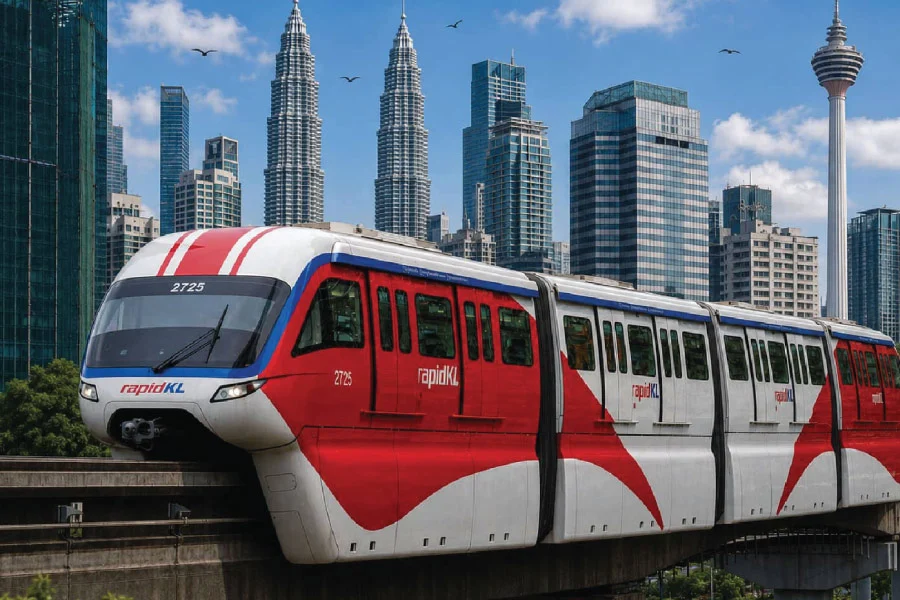
The KL Monorail is an elevated urban rail line operated by Rapid Rail as part of the Rapid KL public transport network.
Unlike conventional LRT and MRT trains, which run on two steel rails, monorail trains travel along a single concrete guideway. Almost the entire KL Monorail route is elevated, giving passengers views of the streets, buildings, and neighbourhoods below.
The line mainly functions as an inner-city connector. Rather than travelling far into the suburbs, it links several important commercial and tourism districts within central Kuala Lumpur.
Its two terminal stations are:
- KL Sentral in the south
- Titiwangsa in the north
Between them, the line passes through Brickfields, the Bukit Bintang shopping district, the Golden Triangle, Jalan Sultan Ismail, and Chow Kit.
Rapid KL describes the Monorail as an intra-city system connecting key destinations within Kuala Lumpur and integrating with the wider Klang Valley rail network.
KL Monorail Route Overview
The KL Monorail has 11 stations:
- KL Sentral
- Tun Sambanthan
- Maharajalela
- Hang Tuah
- Imbi
- Bukit Bintang
- Raja Chulan
- Bukit Nanas
- Medan Tuanku
- Chow Kit
- Titiwangsa
The line is identified as Line 8 on the Klang Valley Integrated Transit Map and is normally shown in light green.
Unlike the Ampang and Sri Petaling Lines, the Monorail does not branch. Trains simply travel in either direction:
- Towards KL Sentral
- Towards Titiwangsa
This makes the route relatively easy for first-time passengers to understand.
KL Monorail Stations and Nearby Attractions
Each station serves a different part of central Kuala Lumpur.
1. KL Sentral
KL Sentral is the southern terminus of the Monorail and Kuala Lumpur’s main transport hub.
The Monorail station is connected to the main KL Sentral complex through NU Sentral, although passengers must walk through the shopping centre and exit the paid area when transferring to most other rail services.
Connections available around KL Sentral include:
- LRT Kelana Jaya Line
- KTM Komuter
- KLIA Express
- KLIA Transit
- MRT Kajang Line via Muzium Negara
- Local and long-distance buses
- Taxis and ride-hailing services
Passengers arriving from Kuala Lumpur International Airport can take the airport train to KL Sentral before transferring to the Monorail.
Our guides to KLIA Express vs KLIA Transit, KL Airport to the City Centre, and KL Sentral explain these connections in greater detail.
Nearby places include:
- NU Sentral
- Little India, Brickfields
- Thean Hou Temple, reached by a short onward ride
- National Museum, via Muzium Negara MRT station
2. Tun Sambanthan
Tun Sambanthan station serves the southern side of Brickfields and is convenient for exploring Kuala Lumpur’s Little India neighbourhood.
Nearby places include:
- Little India Brickfields
- Buddhist Maha Vihara
- Vivekananda Ashrama
- Traditional Indian restaurants and shops
- Methodist College Kuala Lumpur
The station may be more convenient than KL Sentral for some hotels and restaurants located farther south along Jalan Tun Sambanthan.
3. Maharajalela
Maharajalela station is located near the southern edge of Chinatown and the historic Jalan Petaling area.
Nearby destinations include:
- Merdeka 118
- Stadium Merdeka
- Stadium Negara
- Kwai Chai Hong
- Petaling Street
- Chan She Shu Yuen Clan Ancestral Hall
The walk to Chinatown is longer than from Pasar Seni or Plaza Rakyat, but Maharajalela can be useful for approaching the neighbourhood from the south.
Visitors interested in the city’s independence history can combine this stop with our guide to Stadium Merdeka.
4. Hang Tuah
Hang Tuah is one of the KL Monorail’s most important interchange stations.
Passengers can transfer here to the:
- LRT Ampang Line
- LRT Sri Petaling Line
The interchange provides onward connections towards Masjid Jamek, Ampang, Bandar Tasik Selatan, Bukit Jalil, Puchong, and Putra Heights.
Nearby destinations include:
- Lalaport Bukit Bintang City Centre
- Berjaya Times Square
- Hang Tuah district
- Jalan Pudu
- Former Pudu Jail site
Our complete LRT Ampang and Sri Petaling Line guide explains the two branching routes and how to choose the correct train.
5. Imbi
Imbi is the nearest Monorail station to Berjaya Times Square, one of Kuala Lumpur’s largest shopping and entertainment complexes.
Nearby places include:
- Berjaya Times Square
- Berjaya Times Square Theme Park
- Imbi Market area
- Jalan Imbi
- Restaurants and hotels around Bukit Bintang
The station is connected to Berjaya Times Square by an elevated pedestrian walkway, making it especially convenient during hot or rainy weather.
6. Bukit Bintang
Bukit Bintang is the busiest and most tourist-oriented stop on the KL Monorail.
The station is located in the heart of Kuala Lumpur’s main shopping, dining, and nightlife district. It is also within walking distance of the MRT Kajang Line’s Bukit Bintang station, although passengers must exit and walk between the two stations rather than make an in-system transfer.
Nearby destinations include:
- Pavilion Kuala Lumpur
- Lot 10
- Fahrenheit88
- Sungei Wang Plaza
- Plaza Low Yat
- Jalan Alor
- Changkat Bukit Bintang
- The Exchange TRX, via MRT or a longer walk
The Monorail is particularly useful for travelling between KL Sentral and Bukit Bintang without using a taxi or ride-hailing service.
For more ideas in the area, see our guides to Bukit Bintang, Jalan Alor, and the Best Shopping Malls in Kuala Lumpur.
7. Raja Chulan
Raja Chulan station serves the northern side of Bukit Bintang and part of Kuala Lumpur’s Golden Triangle.
Nearby destinations include:
- Pavilion Kuala Lumpur
- Kuala Lumpur Convention Centre
- Jalan Raja Chulan
- Changkat Bukit Bintang
- Hotels along Jalan Sultan Ismail
- Restaurants and offices within the Golden Triangle
A covered pedestrian network around Pavilion Kuala Lumpur also provides onward walking access towards KLCC, although the journey is considerably longer than taking the Kelana Jaya Line directly to KLCC station.
8. Bukit Nanas
Bukit Nanas station is useful for reaching attractions around Jalan P. Ramlee and the northern side of the Golden Triangle.
Nearby destinations include:
- Kuala Lumpur Tower
- KL Forest Eco Park
- Jalan P. Ramlee
- Hotels and offices around Jalan Sultan Ismail
Bukit Nanas is connected by a covered pedestrian walkway to Dang Wangi station on the LRT Kelana Jaya Line. This is a walking connection rather than a direct paid-area interchange.
Passengers transferring at Dang Wangi can continue towards KLCC, Kampung Baru, Masjid Jamek, KL Sentral, Petaling Jaya, and Gombak.
Our LRT Kelana Jaya Line guide covers the full route and its most useful stations.
9. Medan Tuanku
Medan Tuanku station serves Jalan Sultan Ismail, Jalan Tuanku Abdul Rahman, and the Quill City Mall area.
Nearby places include:
- Quill City Mall
- Maju Junction
- Jalan Tuanku Abdul Rahman
- Heritage buildings around Chow Kit
- Hotels and offices along Jalan Sultan Ismail
An elevated walkway links the area with Sultan Ismail station on the Ampang and Sri Petaling Lines, although passengers must walk between the two services.
10. Chow Kit
Chow Kit station provides access to one of Kuala Lumpur’s most distinctive historic neighbourhoods.
Nearby destinations include:
- Chow Kit Market
- Jalan Tuanku Abdul Rahman
- Kampung Baru’s northern side
- Hospital Kuala Lumpur
- Local textile shops and restaurants
The Chow Kit area offers a more local experience than Bukit Bintang or KLCC, with traditional markets, long-established businesses, and busy street scenes.
Visitors exploring this district may also find our complete Chow Kit neighbourhood guide useful.
11. Titiwangsa
Titiwangsa is the northern terminus of the KL Monorail and one of the most important interchange hubs in the city.
Passengers can transfer to:
- LRT Ampang Line
- LRT Sri Petaling Line
- MRT Putrajaya Line
- Rapid KL buses
These connections make Titiwangsa useful for travelling towards Putrajaya, TRX, Ampang Park, Sentul, Sungai Buloh, Hospital Kuala Lumpur, and destinations along the Ampang and Sri Petaling corridors.
The surrounding bus terminal also serves several local and intercity services.
Nearby destinations include:
- Titiwangsa district
- Hospital Kuala Lumpur
- Istana Budaya
- National Art Gallery
- Titiwangsa Lake Gardens, reached by a short onward journey
Main KL Monorail Interchanges
The Monorail connects with several other rail lines, although not every connection is located within the same paid station area.
| Monorail station | Connecting service | Type of connection |
|---|---|---|
| KL Sentral | Kelana Jaya Line, KTM, KLIA Express and KLIA Transit | Walk through KL Sentral or NU Sentral |
| Hang Tuah | Ampang and Sri Petaling Lines | Direct station interchange |
| Bukit Bintang | MRT Kajang Line | Short street-level walk |
| Bukit Nanas | Kelana Jaya Line at Dang Wangi | Covered pedestrian connection |
| Medan Tuanku | Ampang and Sri Petaling Lines at Sultan Ismail | Pedestrian connection |
| Titiwangsa | Ampang Line, Sri Petaling Line and MRT Putrajaya Line | Integrated interchange |
The Rapid KL integrated map confirms connections between the Monorail and the wider LRT, MRT, airport rail, and KTM network.
Top Attractions Accessible by KL Monorail
The Monorail is particularly useful for visitors because many popular attractions are located near its stations.
Little India, Brickfields
Nearest stations: KL Sentral or Tun Sambanthan
Brickfields is known for Indian restaurants, sweet shops, textile stores, temples, colourful arches, and lively streets. Tun Sambanthan is often the better stop for exploring the southern side of Little India.
Stadium Merdeka and Merdeka 118
Nearest station: Maharajalela
Maharajalela provides access to Kuala Lumpur’s historic independence precinct, including Stadium Merdeka and the towering Merdeka 118 development.
Lalaport Bukit Bintang City Centre
Nearest station: Hang Tuah
Lalaport BBCC sits beside Hang Tuah station and contains shops, restaurants, event spaces, and rooftop areas.
Berjaya Times Square
Nearest station: Imbi
Imbi station provides direct access to the shopping centre, indoor theme park, hotel, and surrounding retail district.
Bukit Bintang
Nearest station: Bukit Bintang
This is the best stop for Pavilion Kuala Lumpur, Lot 10, Jalan Alor, Changkat Bukit Bintang, and the central shopping district.
Kuala Lumpur Tower
Nearest station: Bukit Nanas
The station is within walking distance of the entrance area, although the route involves an uphill section. Some visitors may prefer a short ride-hailing journey from the station.
Chow Kit Market
Nearest station: Chow Kit
The market is one of Kuala Lumpur’s largest traditional markets and offers a glimpse of everyday local commerce beyond the major tourist districts.
How to Use the KL Monorail
Using the KL Monorail is straightforward because it has only one route and two directions.
Step 1: Identify your destination
Check whether your destination is closer to KL Sentral or Titiwangsa.
Step 2: Follow the correct platform signs
Trains operate in two directions:
- KL Sentral-bound
- Titiwangsa-bound
Step 3: Purchase a token or use a travel card
Tap your card or token at the entry gate, keep it throughout the journey, and tap or insert it again when exiting.
Step 4: Check whether a transfer requires walking
Connections at Hang Tuah and Titiwangsa are relatively straightforward. Transfers at Bukit Bintang, Bukit Nanas, Medan Tuanku, and KL Sentral may involve exiting the station and walking to another service.
How to Pay for the KL Monorail
The KL Monorail uses Rapid KL’s integrated fare system.
Passengers can generally pay with:
- Touch ’n Go card
- Single-journey token
- Eligible Rapid KL travel passes
Fares are calculated according to the distance travelled. Rapid KL provides an integrated fare calculator covering LRT, MRT, Monorail, and BRT journeys paid using cashless cards or tokens.
A Touch ’n Go card is usually the most convenient choice for travellers making multiple journeys because it can also be used on Kuala Lumpur’s MRT, LRT, and many bus services.
KL Monorail Operating Hours and Frequency
KL Monorail services generally begin at approximately 6:00am and operate until around midnight. The precise final train depends on the station and direction of travel, so passengers making late journeys should check the station timetable before travelling.
Rapid KL lists a peak-hour Monorail headway of approximately six minutes, although actual waiting times can vary because of passenger demand, operating conditions, or service disruptions.
Service frequency may be lower during off-peak periods, weekends, or temporary operational changes. Rapid KL recommends checking its official channels or journey-planning tools for current service information.
Is the KL Monorail Good for Tourists?
Yes. The Monorail is one of the most useful public transport services for visitors staying in or exploring central Kuala Lumpur.
It is particularly convenient for travelling between:
- KL Sentral and Bukit Bintang
- Brickfields and Berjaya Times Square
- Bukit Bintang and Chow Kit
- KL Sentral and Titiwangsa
- Bukit Bintang and Kuala Lumpur Tower
However, it does not directly serve KLCC, Chinatown’s main Pasar Seni station, Batu Caves, or Kuala Lumpur International Airport. These destinations require transfers to other rail lines.
For a more complete view of the network, combine this guide with our articles on the LRT Kelana Jaya Line, LRT Ampang and Sri Petaling Lines, and Kuala Lumpur Bus Guide.
Advantages of Using the KL Monorail
Convenient city-centre route
The Monorail passes through several major tourism, shopping, hotel, and entertainment districts.
Easy to understand
With only one route and two terminal stations, it is less complicated than lines with multiple branches.
Avoids road traffic
The elevated guideway allows trains to bypass congestion on busy roads around Bukit Bintang, Jalan Imbi, and Chow Kit.
Useful connections
The line connects with LRT, MRT, KTM Komuter, airport trains, and local buses at several stations.
Elevated city views
Passengers can see parts of Kuala Lumpur’s streets and skyline from the train, making the journey more visually interesting than underground rail travel.
Limitations of the KL Monorail
Trains can become crowded
The Monorail is heavily used around KL Sentral and Bukit Bintang, especially during peak hours, weekends, and major events.
Some interchanges require walking
Transfers at KL Sentral, Bukit Bintang, Bukit Nanas, and Medan Tuanku are not always within the same paid station area.
Limited geographical coverage
The line mainly serves central Kuala Lumpur and does not extend far into the surrounding suburbs.
Platforms can feel warm
Most stations are elevated and partly open to the weather, so platforms can be hot or humid during the day.
Luggage may be inconvenient
Airport travellers can use the Monorail from KL Sentral, but crowded trains and limited interior space may make large suitcases difficult to manage.
Tips for First-Time Passengers
- Use the Monorail for short journeys around the city centre.
- Avoid weekday rush hours when possible.
- Allow extra walking time when transferring at KL Sentral.
- Use Imbi for Berjaya Times Square and Bukit Bintang for Pavilion and Jalan Alor.
- Check whether Bukit Nanas or Dang Wangi is more convenient for your next connection.
- Keep your belongings secure during crowded journeys.
- Consider the MRT Kajang Line as an alternative between Bukit Bintang and parts of central Kuala Lumpur.
- Check Rapid KL updates before travelling late at night.
- Combine the Monorail with walking, buses, or Grab for destinations farther from stations.
Frequently Asked Questions
Where does the KL Monorail go?
The KL Monorail runs between KL Sentral and Titiwangsa through Brickfields, Hang Tuah, Imbi, Bukit Bintang, Bukit Nanas, Medan Tuanku, and Chow Kit.
How many stations does the KL Monorail have?
The line has 11 stations along an approximately 8.6-kilometre elevated route.
How long does the full Monorail journey take?
A complete journey between KL Sentral and Titiwangsa generally takes around 25 minutes, although the actual time may vary.
Does the KL Monorail go to Bukit Bintang?
Yes. Bukit Bintang has its own Monorail station, located close to Lot 10, Sungei Wang Plaza, Jalan Alor, and Pavilion Kuala Lumpur.
Does the Monorail go to KLCC?
No. The Monorail does not stop at KLCC. Travellers can transfer to the Kelana Jaya Line at Dang Wangi via Bukit Nanas or use the pedestrian route from the Bukit Bintang area.
Does the Monorail go to Kuala Lumpur International Airport?
No. Take the Monorail to KL Sentral and transfer to the KLIA Express or KLIA Transit.
Is KL Sentral Monorail inside the main station?
The Monorail station is beside NU Sentral and connected to the wider KL Sentral complex by a walking route. It is not located directly beside every other platform, so allow additional transfer time.
Which Monorail station is nearest to Berjaya Times Square?
Imbi station is the nearest stop and is connected to the shopping centre by a pedestrian walkway.
Which station should I use for Jalan Alor?
Bukit Bintang is the most convenient Monorail station for Jalan Alor.
Can I transfer from the Monorail to the MRT?
Yes. The most useful connections are Bukit Bintang for the MRT Kajang Line and Titiwangsa for the MRT Putrajaya Line.
Can I use Touch ’n Go on the KL Monorail?
Yes. Touch ’n Go is accepted across Rapid KL’s integrated rail network, including the Monorail.
The KL Monorail is a short but highly useful part of Kuala Lumpur’s public transport network. Its elevated route connects KL Sentral with Brickfields, Bukit Bintang, the Golden Triangle, Chow Kit, and Titiwangsa, making it particularly valuable for visitors exploring the city centre.
For sightseeing, its most useful stops are Maharajalela, Hang Tuah, Imbi, Bukit Bintang, Bukit Nanas, and Chow Kit. Interchanges at Hang Tuah and Titiwangsa also provide access to the wider LRT and MRT network.
The Monorail may not cover as much of the Klang Valley as the MRT or LRT, but for short journeys between central shopping, dining, hotel, and entertainment districts, it remains one of the easiest ways to avoid Kuala Lumpur’s road traffic.